Breast-ROI revision assembled from accepted SNR-like displays, physical-alias v4 g-factor/PPA diagnostics, and v4 NPZ-mask-derived ROI ranking for BI_7, Mammaria_8Ch, Mammaria_12Ch, and Mammaria_18Ch.
Executive Summary and Scope Limits
The primary PPA ROI is the geometry-derived breast imaging volume between medial and lateral H-F/near-vertical conductor elements. It excludes outer unused FOV regions from scaling and ranking where the conductor-derived mask is available.
This remains a simplified relative design comparison. It does not claim electromagnetic simulation, clinical validation, coupling behavior, matching networks, electronics performance, real noise covariance, or measured SNR.
Validation Summary
This public page shows a readable validation summary. The machine-readable contract is copied to tables/final_report_contract.json.
physical-alias v4 breast-ROI maps and summary table
Breast-ROI ranking source
PASS
physical-alias v4 NPZ-mask-derived ROI ranking
Accepted image path policy
PASS
no rejected display image paths selected
Metric Definitions
SNR-like map
Relative receive-sensitivity display from the current STEP trace overlay source. It is a comparative visualization of receive sensitivity behavior and is not measured SNR.
g-Factor
The g-factor is the actual parallel-imaging geometry and noise-amplification penalty. Lower is better. A value near 1 is ideal. High g-factor means that folded positions along the alias direction are locally hard to distinguish from the coil sensitivity profiles. In simplified SENSE-like terms: SNR_PI ~= SNR_full / (sqrt(R) * g). sqrt(R) is the unavoidable acceleration penalty; g is the additional geometry/noise penalty. g-factor is not measured SNR and not absolute clinical image quality. It can only be compared within the same valid acceleration direction, ROI definition, and modeling assumptions.
Condition number
The condition number is a numerical stability diagnostic of the local encoding / unfolding matrix. Lower is better. High condition number means that the local matrix inversion is unstable: small errors, noise, or sensitivity-model changes can cause large changes in the solution. In the 2-norm: cond2(A) = sigma_max / sigma_min. Condition number is not SNR and not the final g-factor. It helps explain why g-factor problems may occur.
Smallest singular value
The smallest singular value is the weakest independent encoding mode of the local sensitivity matrix. Larger is better. Small smin means low encoding margin: there is a combination of folded positions that the channel set can barely distinguish. Small smin often explains high condition number and high g-factor regions. smin is not SNR and not a final quality metric; it is a linear-algebra diagnostic.
Breast ROI
Geometry-derived primary ROI between medial and lateral H-F/near-vertical conductor elements. It is intended to suppress unused outer FOV influence and is not an anatomy mask.
Hotspot
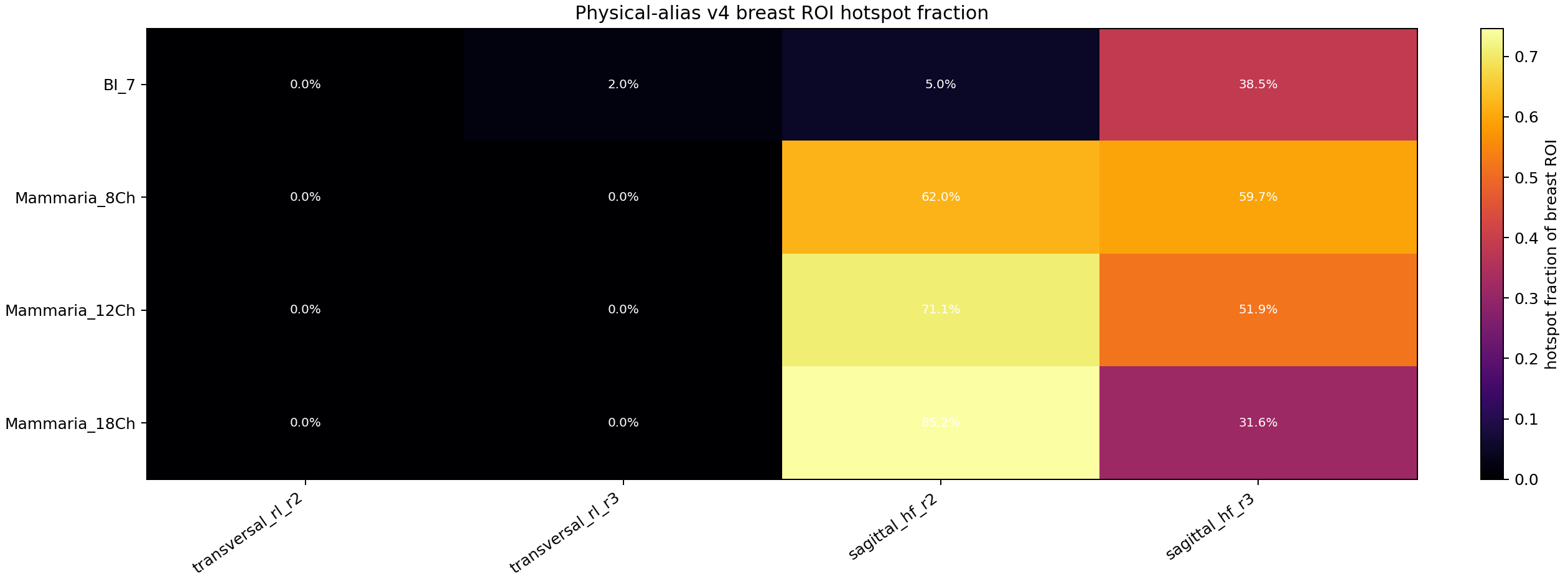
Fraction of breast ROI pixels above an explicit threshold. The v4 threshold is max(2.0, min(3.0, breast-ROI g p95)) for R=2 and max(5.0, min(10.0, breast-ROI g p95)) for R=3.
ROI ranking
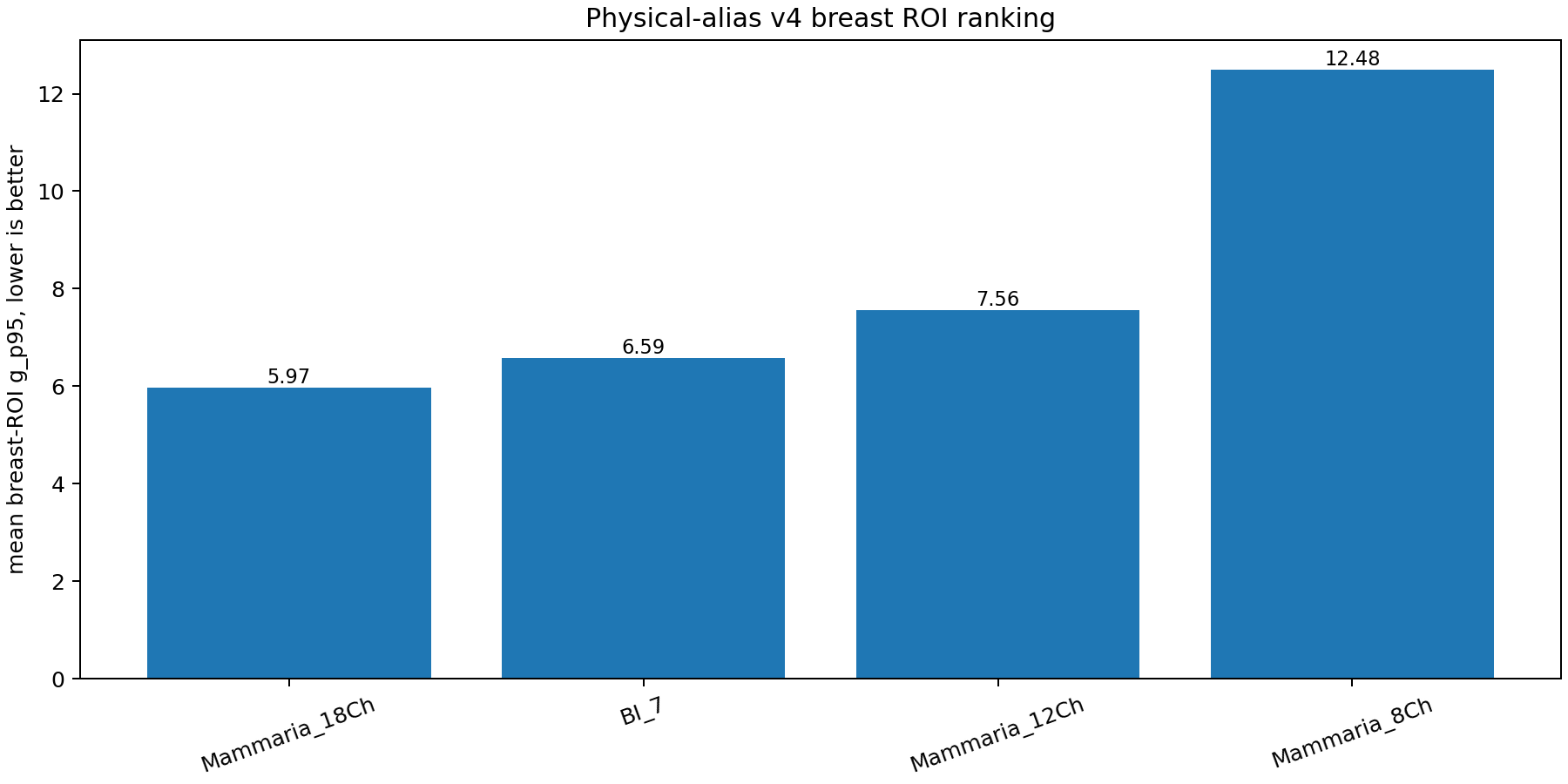
Method-review aggregate setup comparison based primarily on mean breast-ROI g p95 across the accepted conditions, with worst-condition and hotspot views retained to expose condition-specific behavior. It is not a clinical ranking.
Slice position QA
Red straight guide lines mark the evaluated transversal Z, coronal Y, and sagittal X slices. These are separate from the red ROI contours used in the condition maps.
Model limitations
This report is a simplified relative design indicator. It does not claim electromagnetic simulation, clinical validation, coupling behavior, matching networks, electronics performance, real noise covariance, or measured SNR.
SNR Maps
SNR-like source policy for this revision requires the current STEP trace overlay source. The old V8-widebox family is review-only fallback and fails the final contract if selected.
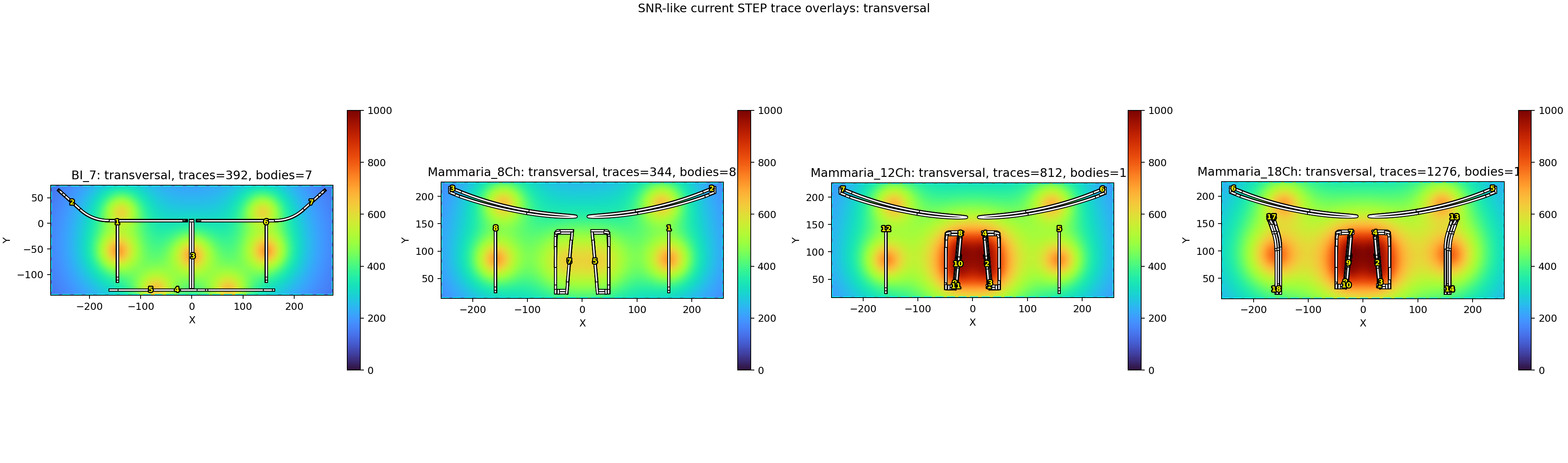
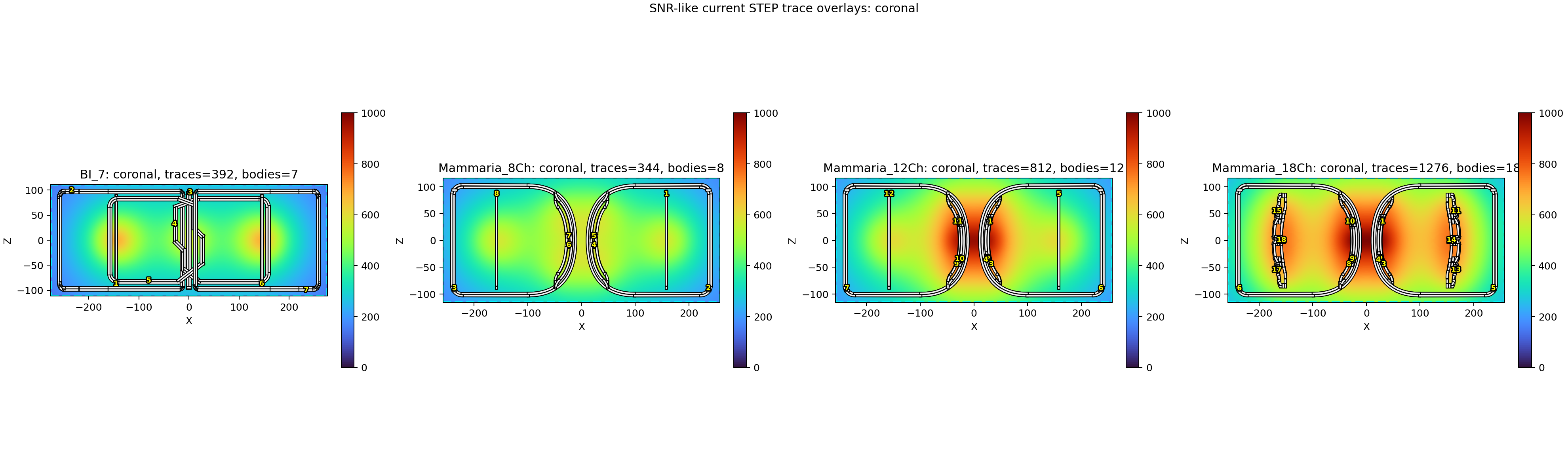
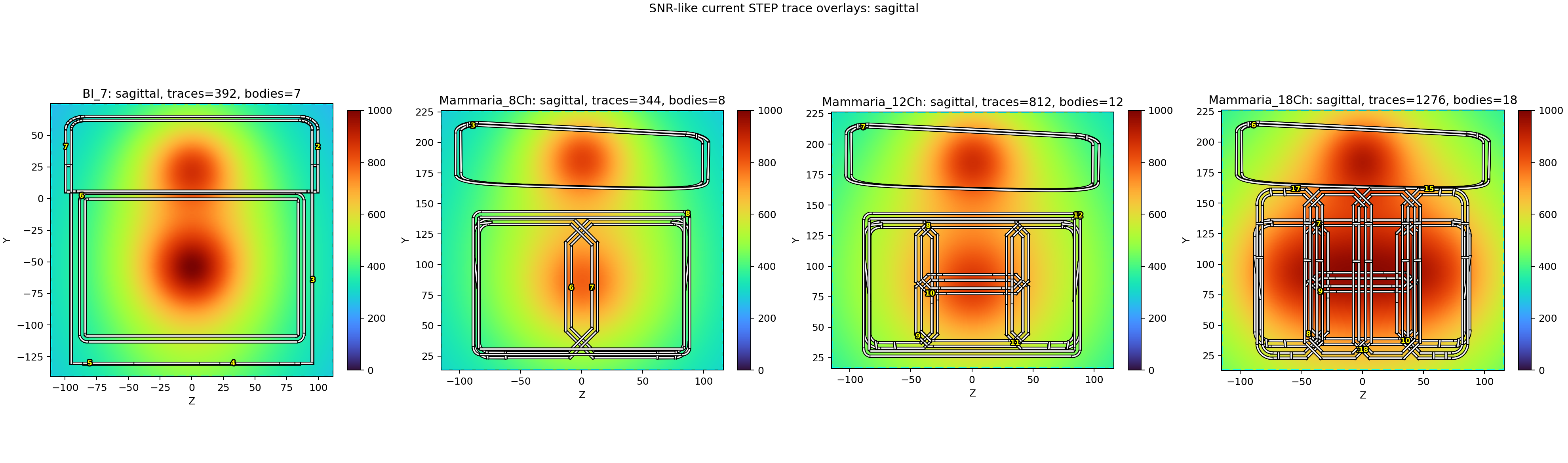
SNR-like overview interpretation. Use these three current STEP-overlay planes to compare relative spatial coverage and conductor placement across the four setups. The displays support qualitative comparison only and should not be read as measured SNR.
SNR-like transversalCurrent STEP trace overlay source with all sampled conductor traces drawn.SNR-like coronalCurrent STEP trace overlay source for superior-inferior and lateral coverage comparison.SNR-like sagittalCurrent STEP trace overlay source for left-right slice comparison.
Slice Position QA
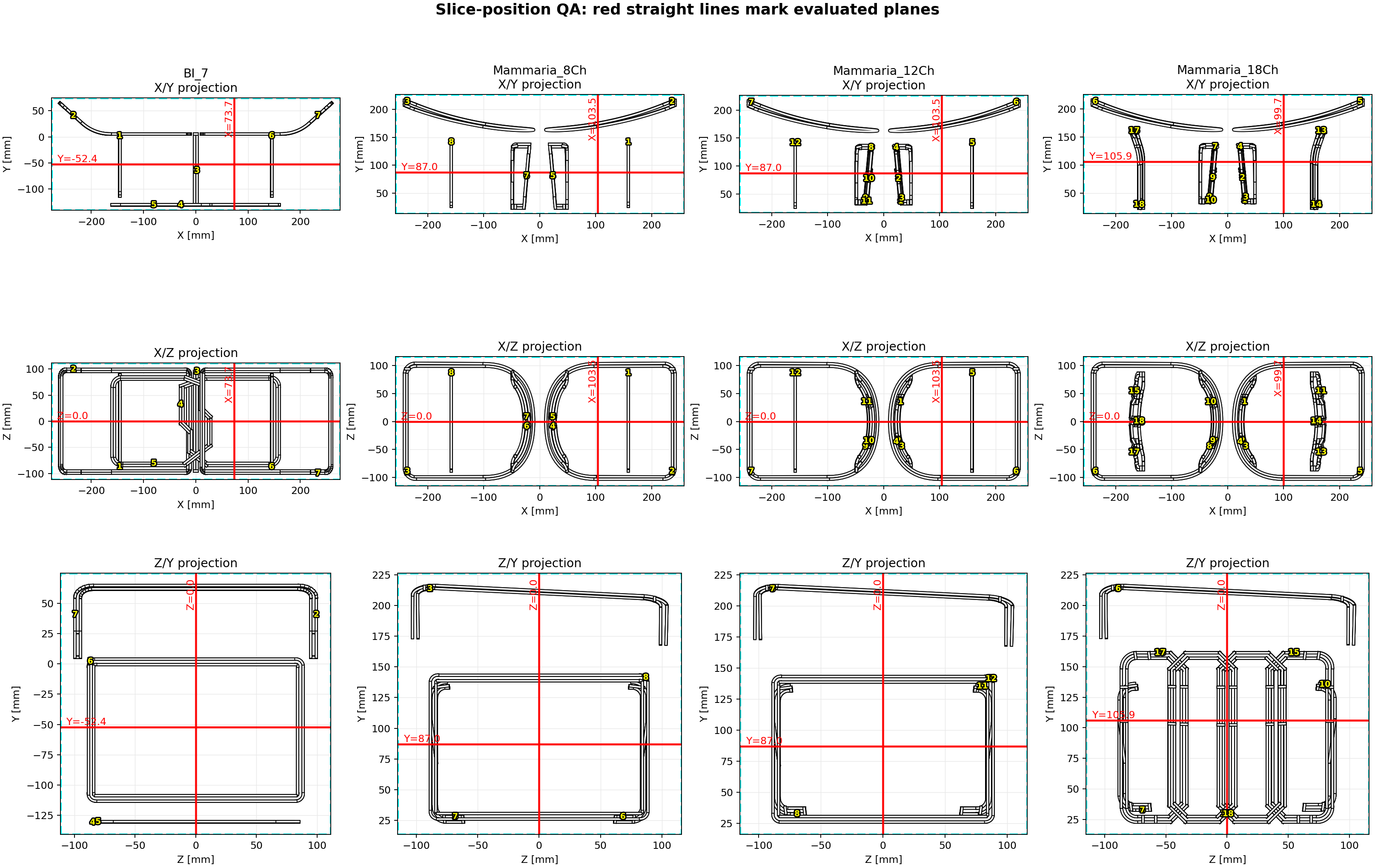
Red straight lines mark the evaluated slice positions: fixed Z for the transversal slice, fixed Y for the coronal slice, and fixed X for the sagittal slice. These straight guide lines are separate from the red ROI contour in the condition maps.
Slice-position QA interpretation. The coronal Y line is setup-specific. The table reports the final value used, the automatic detector value, and any explicit review override. If an override is used, it is labelled as a review override rather than pure automatic detection.
Three-plane slice-position QAX/Y, X/Z, and Z/Y projections with conductor overlays and per-setup sagittal X positions.
Slice Position Table
Setup
transversal_z0_mm
final coronal_y0_mm
coronal policy
automatic coronal_y0_mm
override coronal_y0_mm
sagittal_x0_mm
derivation/source
BI_7
0.0
-52.35067933681667
automatic_lateral_main_vertical_midheight
-52.35067933681667
73.7161372342265
automatic_lateral_main_vertical_midheight
Mammaria_8Ch
0.0
87.01167404000553
automatic_lateral_main_vertical_midheight
87.01167404000553
103.45608161859383
automatic_lateral_main_vertical_midheight
Mammaria_12Ch
0.0
87.01167404000553
automatic_lateral_main_vertical_midheight
87.01167404000553
103.45608161859383
automatic_lateral_main_vertical_midheight
Mammaria_18Ch
0.0
105.91628706755631
automatic_lateral_main_vertical_midheight
105.91628706755631
99.65300425675834
automatic_lateral_main_vertical_midheight
Breast-ROI g-factor and PPA Diagnostics
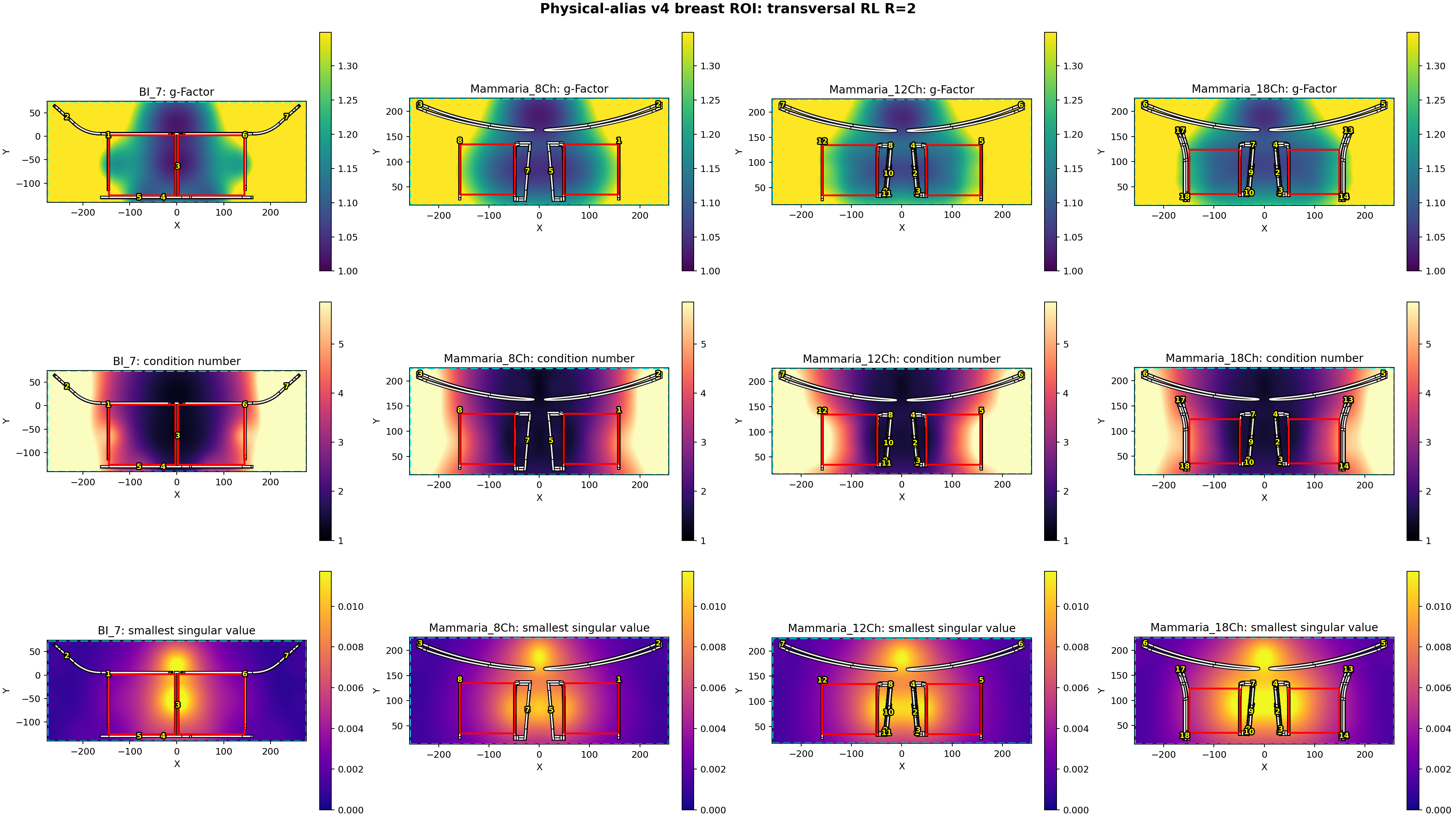
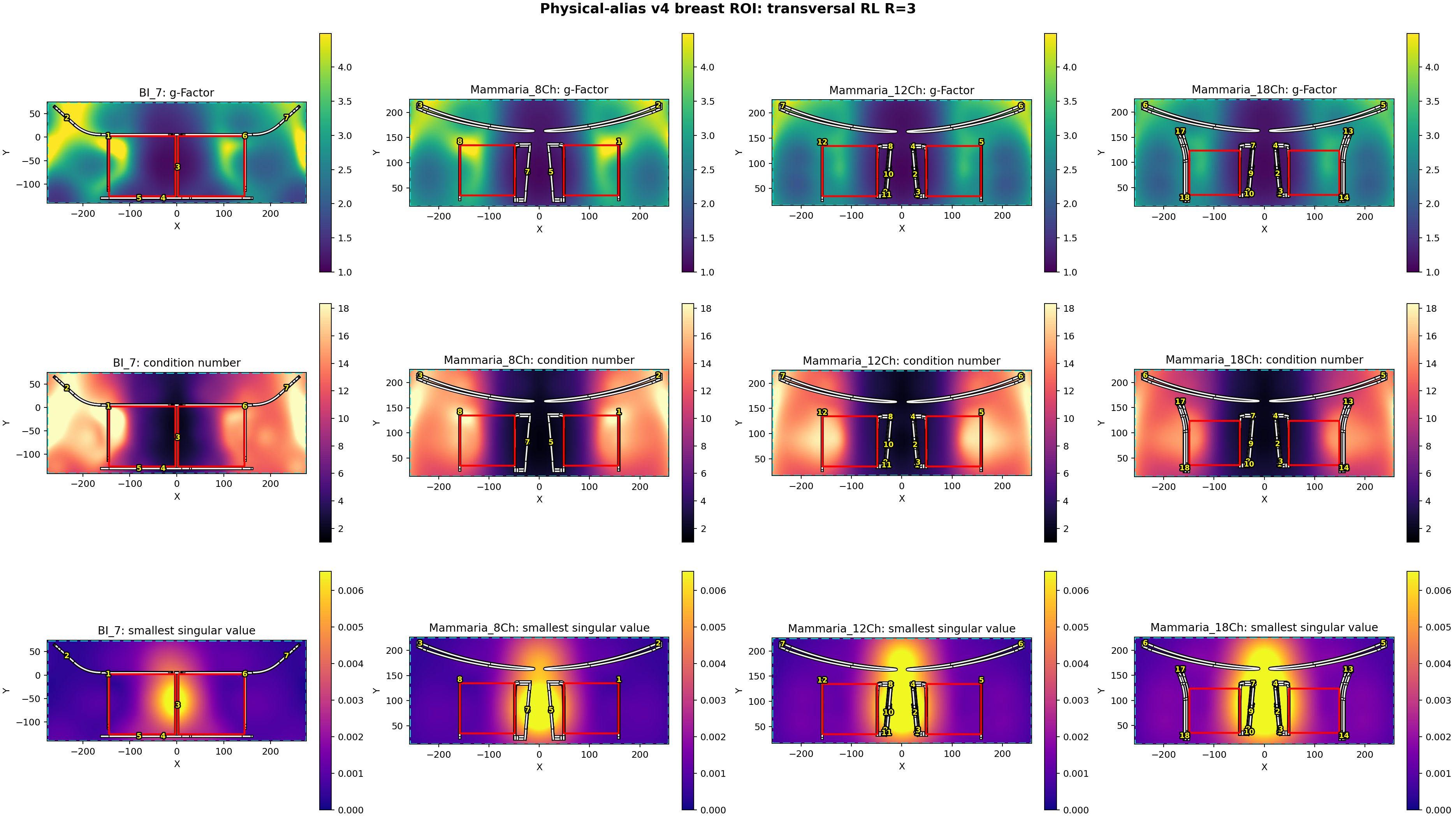
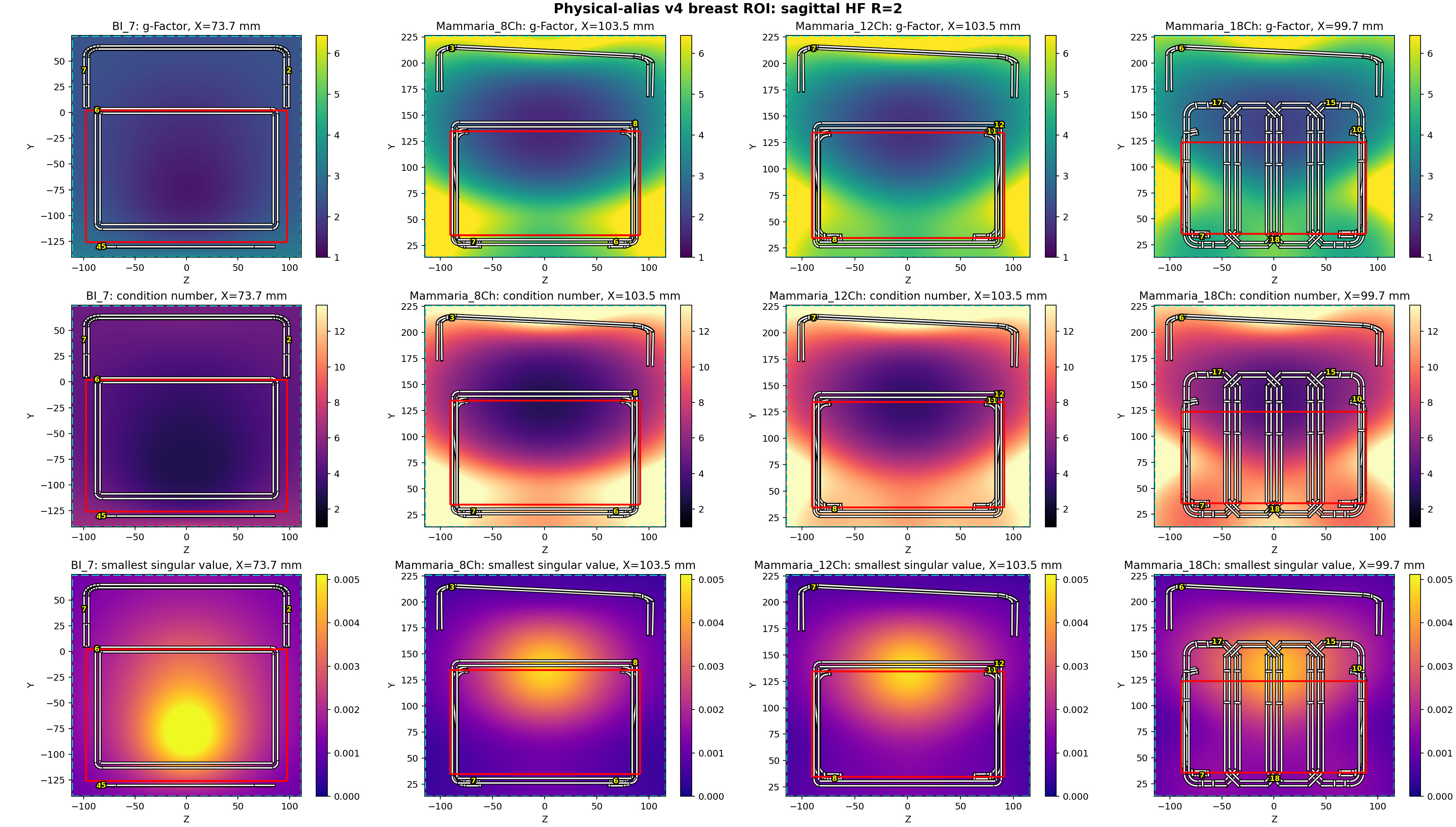
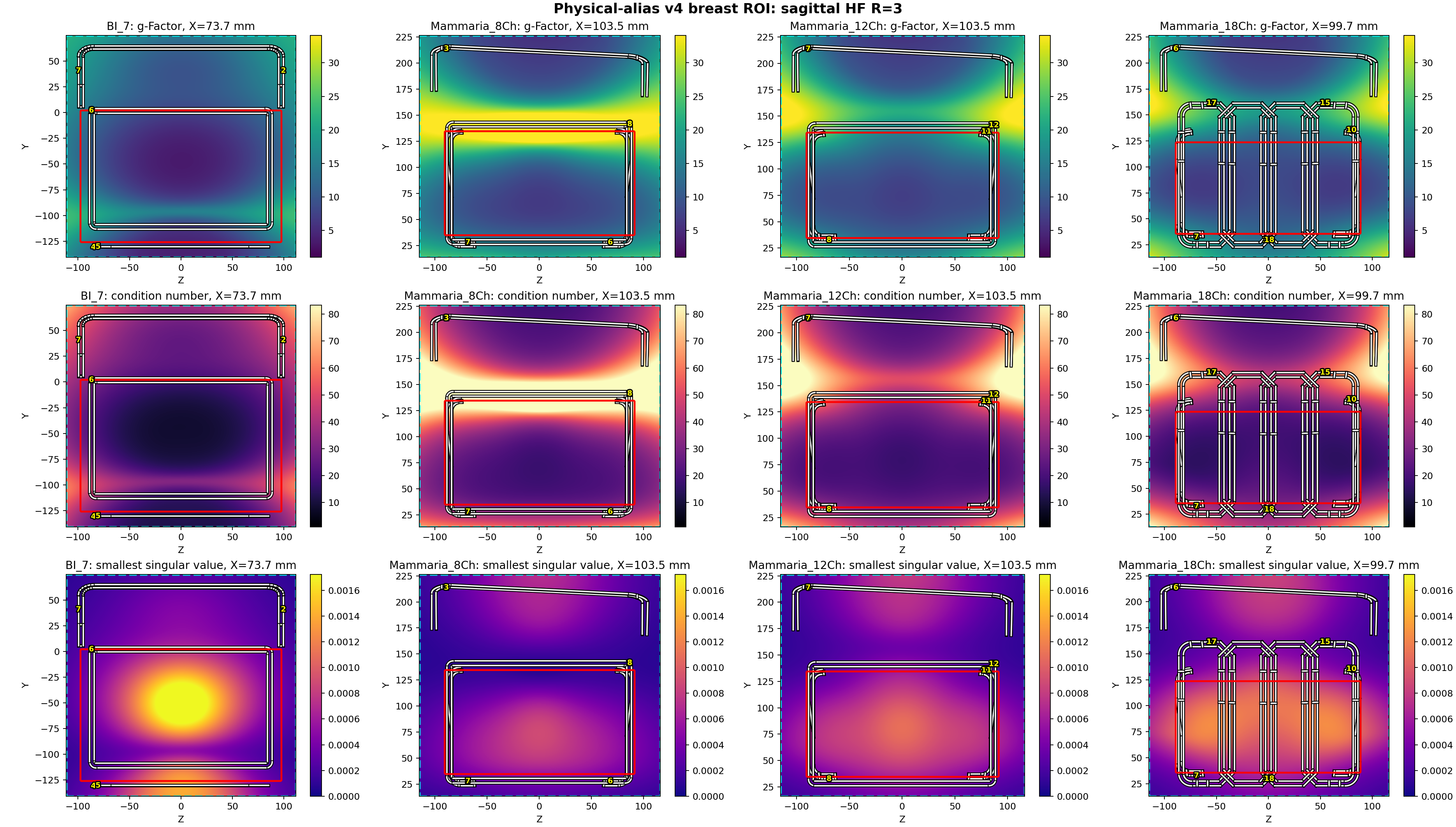
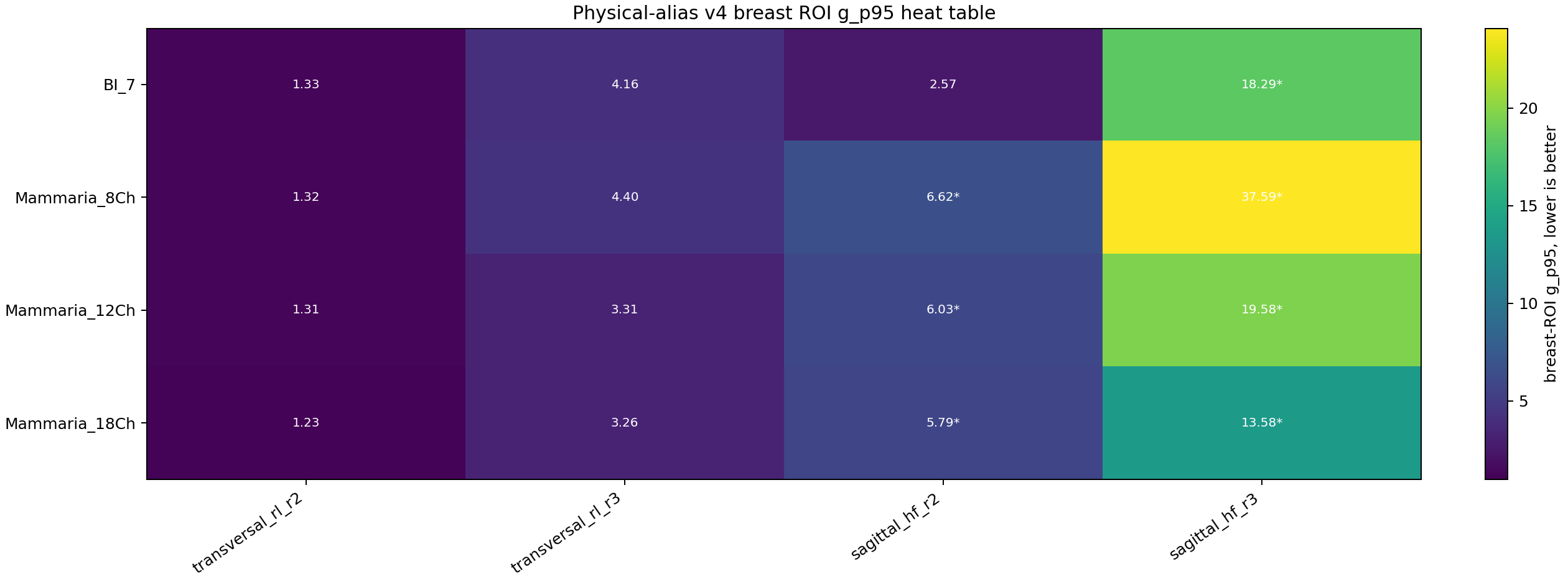
Accepted PPA diagnostics are limited to sagittal H-F and axial/transversal R-L at R=2 and R=3. Red contours show the exact geometry-derived ROI used for scaling and ranking.
Accepted PPA scope. The accepted breast PPA scope is sagittal H-F and axial/transversal R-L only, each at R=2 and R=3. Sagittal R-L, transversal H-F, A-P phase direction, and coronal PPA are excluded from accepted interpretation.
Transversal PPA interpretation. In transversal maps, the valid accepted phase/alias direction is R-L. Review the breast-ROI-scaled g-factor, condition number, and smallest singular value panels for local instability inside the red ROI boundary.
Sagittal PPA interpretation. In sagittal maps, the per-setup X slice is retained from the v3 medial/lateral slice logic and the valid accepted phase/alias direction is H-F. Review condition-specific behavior rather than total channel count alone.
transversal RL R=2Physical-alias v4 diagnostic panel with breast-ROI robust scaling and red ROI boundary.transversal RL R=3Physical-alias v4 diagnostic panel with breast-ROI robust scaling and red ROI boundary.sagittal HF R=2Physical-alias v4 diagnostic panel with breast-ROI robust scaling and red ROI boundary.sagittal HF R=3Physical-alias v4 diagnostic panel with breast-ROI robust scaling and red ROI boundary.
Breast ROI Ranking, Heat Tables, and Hotspots
Ranking is method-review only. It is based on accepted PPA conditions and on the v4 NPZ mask when present. Fallback is allowed only for missing masks and is labeled explicitly.
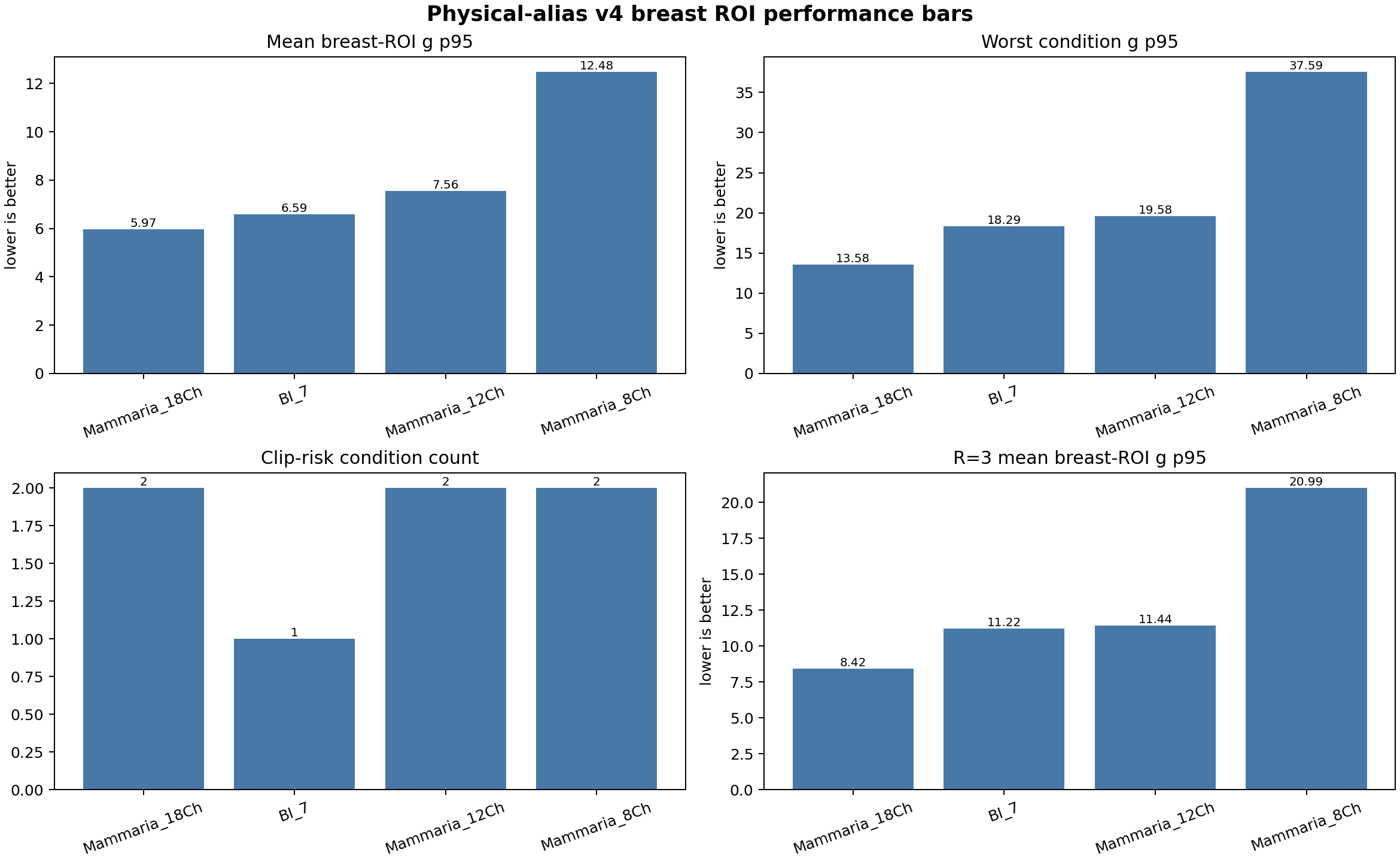
Breast ROI ranking by mean g p95Lower aggregate g p95 is better under the geometry-derived breast ROI rule.PPA/g-factor performance barsMean g p95, worst g p95, clip-risk count, and R=3-only mean g p95 by setup.Breast-ROI g p95 heat tableEach cell is one setup and one accepted valid condition; data fields carry risk flags.Breast ROI hotspot summaryHotspot fraction of ROI by setup and accepted condition.
ROI ranking interpretation. The aggregate rank is a compact method-review summary, not a replacement for map review and not a clinical ranking. A setup can rank close to another overall while still improving selected directions or accelerations.
Hotspot interpretation. Hotspot fraction quantifies how much of the breast ROI exceeds the explicit R-dependent threshold. Small concentrated hotspots can matter even when aggregate mean g p95 is close.
Ranking Preview
rank_by_mean_g_p95
coil
mean_g_p95
worst_g_p95
clip_risk_conditions
1
Mammaria_18Ch
5.966164039571545
13.581063010920813
2
2
BI_7
6.5874477024734945
18.292166820148054
1
3
Mammaria_12Ch
7.556774627698841
19.580636855997728
2
4
Mammaria_8Ch
12.483730974935753
37.58584736826873
2
Hotspot Preview
coil
condition
hotspot_threshold
hotspot_fraction_roi
hotspot_pixels
BI_7
transversal_rl_r2
2.0
0.0
0
BI_7
transversal_rl_r3
5.0
0.01979405034324943
173
BI_7
sagittal_hf_r2
2.565481378420473
0.05
665
BI_7
sagittal_hf_r3
10.0
0.38533834586466165
5125
Mammaria_8Ch
transversal_rl_r2
2.0
0.0
0
Mammaria_8Ch
transversal_rl_r3
5.0
0.0
0
Mammaria_8Ch
sagittal_hf_r2
3.0
0.6197883597883598
5857
Mammaria_8Ch
sagittal_hf_r3
10.0
0.596931216931217
5641
Expert Comparison
Read the method-review ranking together with the red ROI boundaries and the condition-specific diagnostics. The ROI is geometry-derived from conductor placement and does not establish anatomy or clinical performance.
Setup
Rank
Mean g p95
Worst g p95
High-risk conditions
Clip-risk conditions
BI_7
2
6.5874477024734945
18.292166820148054
3
1
Mammaria_8Ch
4
12.483730974935753
37.58584736826873
2
2
Mammaria_12Ch
3
7.556774627698841
19.580636855997728
2
2
Mammaria_18Ch
1
5.966164039571545
13.581063010920813
2
2
Current Conclusion and Method Limitations
The current accepted-condition method-review ranking favors Mammaria_18Ch over BI_7 by mean breast-ROI g p95. Mammaria_18Ch should still be reviewed condition by condition; total channel count helps only when added elements provide independent sensitivity variation along the accepted alias direction inside the ROI. Its copied mean g p95 is 5.966164039571545.
This revision reduces outer-FOV influence by using the geometry-derived breast ROI for scaling, ranking, and hotspot summaries. Manual review must still confirm that the red ROI boundaries plausibly bracket the breast imaging volume for every setup and condition.
The conclusion remains conservative: no clinical validation, electromagnetic simulation claim, measured SNR claim, or hardware electronics claim is made here.